
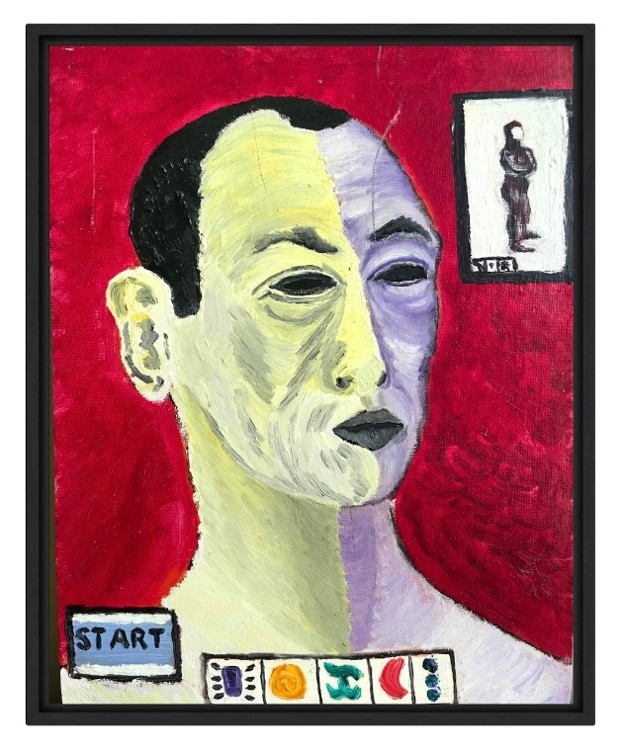
Walking home from the school bus, last December, my six-year-old grandnephew spotted something red ahead on the sidewalk. He bolted away from his older sister to claim the flat object before she could. Resting on the ground was a painted portrait of a man, his face split into two halves of yellow and lavender. His eyes were empty pits of black, like a mask from ancient Greek theatre. The background was blood red. Magnus picked up his treasure and took it home.
His father was less sanguine about the find. Magnus’ parents were trying to sell their house, so incorporating more of anything was problematic. His father suggested to Magnus that his great-uncle might like the painting. That is how it came to be in my possession.
The painting is not pretty, but it does stand out. Below the face, on the left side, is a button labelled “Start” and beside this is a panel with five enigmatic symbols. To the right of the man’s head is a small figure, a homunculus, framed in a box of lines.
Spiral nails held the painting onto the cheap white frame, along with improvised wires to hang it. In addition to the name “Kevin” signed on the painting’s back, there was a little yellow round sticker showing the painting had been for sale but was “on hold.” A card taped to the back from December 2018 advertised an art exhibition of a Kevin Whitaker from a gallery in Roncesvalles Village.
I sent an email to the gallery, saying I had come into possession of one of their artist’s paintings. I found the coordinates of the widow of the artist – Kevin Whitaker passed away in early 2025 – and contacted her as well.
Kevin Whitaker was a lawyer and once the Chair of the Ontario Labour Relations Board and special advisor to the Ontario government. He was also an Ontario Superior Court Justice. Diagnosed in 2016 with Lewy Body Dementia and Parkinson’s Disease, he faced a future of increasing movement challenges – such as stiffness, slowness, and tremor – and progressive changes in thinking, attention, mood, and perception, including hallucinations. Realizing it would affect his ability to serve effectively, Kevin resigned his position. In 2018, Kevin became a full-time artist, raising over $200,000 for research into those diseases through his art.
The gallery owner was surprised and wanted to know where Magnus found the painting. She would let the artist’s wife know the painting had been found, adding that “perhaps someone was moving things, and it got dropped.”
Kevin’s widow, Marie, responded that the painting was one of her husband’s earliest and favourites — it was a self portrait. She wondered if the painting had been stolen from the gallery and asked me to thank Magnus for recovering it. Marie was “more than happy to gift” the painting to me, if I liked it, otherwise it should be returned to the gallery.
Their responses posed a dilemma. If the painting had been in the gallery’s possession, I was hesitant to return it, given their apparent carelessness in protecting it. If it was not in their possession, perhaps the painting had been disposed of by a local landlord, after the tenant who had it moved out or passed away.
Marie appointed me caretaker of the painting until she found its legitimate owner. I accepted the offer.
The following day Marie contacted me with the news she had found a photograph of the painting and remembered Kevin giving it to a colleague. The photograph was of the two with the painting at an exhibition. “First” was the title of the painting, printed on the card beside it, with a red sticker suggested the painting had been sold.
Marie contacted Kevin’s former colleague who explained she had given the painting to a young woman who admired it and whose name she could not remember. Satisfied that she had found the rightful owner, Marie wrote to me: “I am feeling particularly blessed by our exchange and the efforts you have taken to find me and return the painting, which is now rightfully yours.”
As an early work, one of Kevin’s first after his diagnosis, “Start” may capture his feelings at the time of its creation. The bifurcation of Kevin’s face into yellow and lavender halves may depict how he felt about his transition from the healthy Kevin into whatever unknowns lay ahead, from emotion to detachment, from instrumental to dependent, from judging to judged. There is an obvious split into two selves – a fractured identity — one warmer yet pallid and one cooler and mournful. Both identities exist at the same time at this point in Kevin’s journey.
At the bottom of the painting, the start button might depict the finality of Kevin’s situation: that once pressed, a series of events will be initiated and unfold in the sequence communicated by the icons to the right of the button. What precisely each icon means may be less important than that they communicate a predictable and irrevocable progression towards an endpoint. That endpoint is the three vertical dots, an ellipsis, suggesting that what follows is evident and does not need to be said.
To Kevin’s left, the faceless superhero in the box might be Kevin himself but abstracted as a case or a specimen, set apart to be observed, or studied as if Kevin understands that he will be a witness to his own transformation.
While not visually attractive, or a testimony to his mastery of painting technique like his later works, the painting is raw with emotion and apprehension. What is profound, and a testament to Kevin, is the tension between the pressing of the button that sets the unstoppable process in motion and Kevin knowing that the button had already been pushed as he was painting it. Yet Kevin kept painting.
Kevin lived for 9 more years after his diagnosis, finding joy in his painting and his family. He died on New Years Day in 2025 surrounded by both.